
✨“I have to access my inner gym-rat, the bro-iest part of my soul”: Holly M. Wendt on getting the words on the page✨
Plus, what to do when you have writer's burnout; the industry trends you need to know about, and four questions every BIPOC writer should ask a potential agent✨
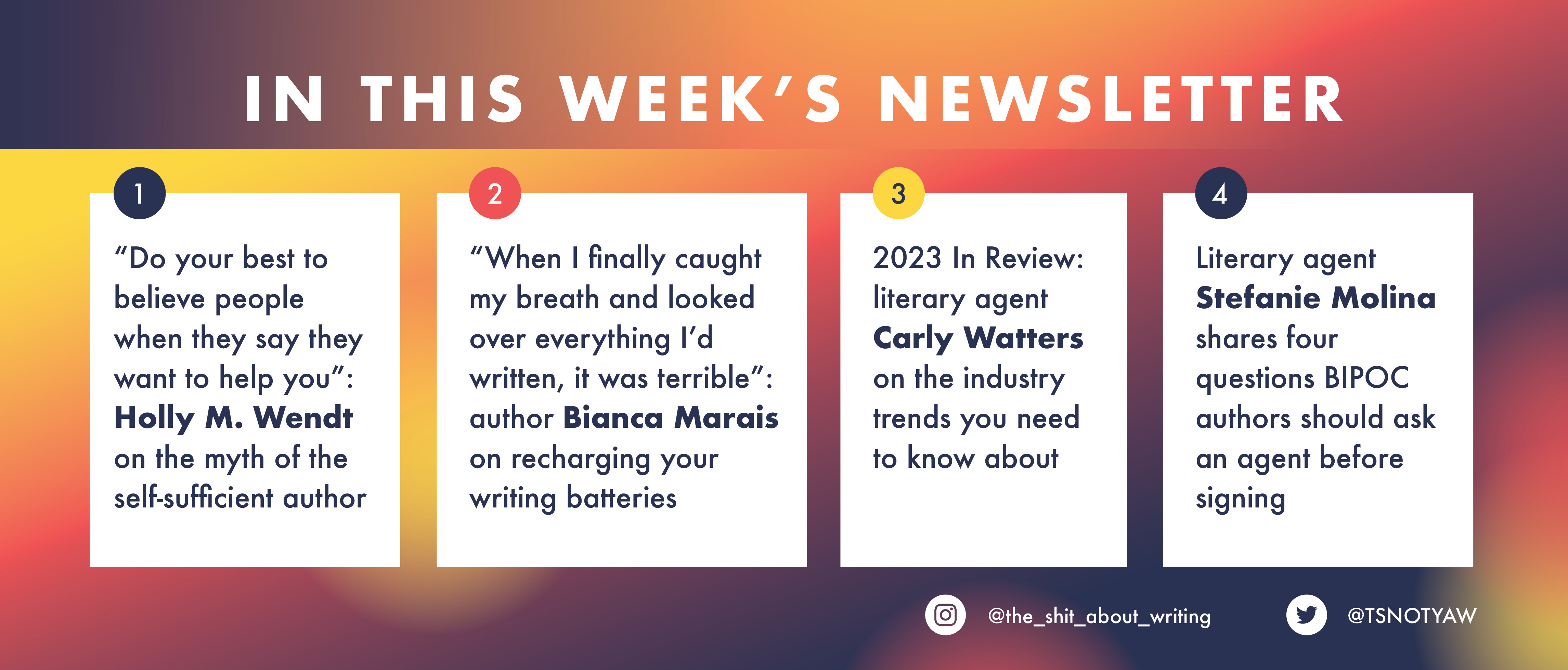
Hello friend! We’re so happy to see you! At the end of each month the team at The Shit No One Tells You About Writing puts together a bumper newsletter full of actionable writing tips and real-world insight from bestselling authors and publishing industry experts. And this month is no exception! We’ve got loads in store for you so let’s dive in...
❤️ The Shit No One Tells You About Writing Team
SHELF LIFE with Holly M. Wendt
SHELF LIFE caught up with the writer, artist, and English and Creative Writing professor to discuss building a writing community when you don’t live in New York, learning the hard way to accept help when people offer, and accessing your inner gym-rat to hit your word count.
Holly M. Wendt is an Associate Professor of English and Creative Writing at Lebanon Valley College and the author of Heading North which launched this month. They have been a fellow at the Kenyon Review Writers Workshop and have attended Bread Loaf, Sewanee, and Tin House. Their work has appeared in Passages North, Shenandoah, The Rumpus, and elsewhere. Holly is a first-generation college student and lives in Pennsylvania.
SHELF LIFE: Is there a particular piece of writing advice that resonated with you while writing Heading North?
HOLLY M. WENDT: Persist. This was an eleven-year journey, full of drafts that weren’t right and query letters unanswered and submissions rejected. There were almosts and near-misses and opportunities I hoped for that didn’t pan out. So to persist—at the level of craft and being committed to becoming a better writer so the book can be a better book and at the level of pursuing publication and at the journey of the self becoming better at asking for help, which is absolutely necessary if a book is going to get into readers’ hands—is the best advice I know.
SL: You have spoken about how your relative isolation has shown you how rural stakeholders are often written off. Would you say you have been able to build a strong and supportive writing network despite this? What have you done right?
HMW: I once received a well-meaning piece of advice from an established writer: what I should do with whatever time I had off from my full-time faculty position in rural central Pennsylvania was go to New York, rent an apartment there, go to readings and literary events, and start “networking.” That, this person was sure, would put me in the correct orbits for success.
Aside from the fact that I was neither able nor willing to do that—the cost, the icky feeling of parachuting into someone else’s community under a grasping pretext, the time and energy that needed to be spent writing and preparing for the upcoming semester and not awkwardly pumping strangers for business cards, the cost—I was frankly insulted by the suggestion because it espoused that very write-off at its core: How on earth could someone from beyond the metro area ever hope to make it? (I’ll leave the generational wealth implied by the suggestion for another time.)
It’s frustrating, but I say that advice was well-meaning because it is true that being in the right place at the right time and having connections make a big difference in the industry. But for me, that kind of aspirational literary tourism doesn’t feel authentic. So what I’ve done is try to cherish, maintain, and build my writing network through educational opportunities and shared experiences.
I have a small cadre of much-loved writer-friends: two people I’ve known since my undergraduate days are my first and last readers, and then I have a wider swathe of writers with whom I trade manuscripts at strategic points in the evolution of the work. Rather than being the product of geographical community, my writing network is mostly based on shared learning experiences: we met at a workshop or residency and really clicked.
Because most of us are living that double life of having full-time jobs and other obligations outside of writing—many of my writing partners are parents or caregivers—a way to meet that doesn’t require travel or childcare [such as on Zoom] makes it more accessible and thus more possible to continue the practice.
Keeping that door open—send work when it’s ready, whenever that is, next month or next year—and approaching all of this with generosity of spirit, rather than as a series of fixed creative transactions, has been key for creating and sustaining my writing community from the margins.
SL: In terms of building and maintaining a writing community, is there anything you wish you had done differently?
KM: I wish I’d been more proactive in seeking guidance and mentorship for myself, especially earlier on. When you’ve been raised to think the best thing you can be is self-sufficient, when you’ve devoted a lot of energy to not needing help (so that you never have to “bother” anyone) and thus never learn how to ask for it, when you expect that mentorship is bestowed rather than sought out, it’s very difficult to overcome that resistance. The advice I give my students, so that they can at least benefit from my mistakes, is to do your best to believe people when they say they want to help you and act accordingly.
Of course, there will be times when someone says, “Send me your work!” and you do, and you never hear from them again, or the promised collaboration fizzles out—life gets in the way of even the best intentions sometimes—and that stings, but preemptively deciding the offerer couldn’t have actually meant it and never sending, never asking, never following up is self-defeating.
SL: Do you have a mantra or go-to pep talk for days when the writing feels hard?
HMW: Maybe this is the opposite of a pep talk, but I try to think of it as work. It’s time to get to work. And when I say work, I don’t mean my job, which is when I go to campus and teach five days a week and grade most of the day on Sunday, but what my hands feel called to make.
That sounds so blithe. It’s not. Sometimes I have to access my inner gym-rat, the bro-iest part of my soul, where I can hear my hockey novel’s strength and conditioning coach clapping and shouting, “Time to do work, do work!” inside the weight-room of my head while I stand in front of my alarm clock and will myself away from the bed. And sometimes I fail—bad weeks, the occasional bad month. The fact that I sit with dozens of newer writers on a daily basis and say to them, “It is hard, but we have to keep going anyway,” helps to push me through the bad weeks, too, lest I become a hypocrite. Sometimes I think about my parents who spent their entire working lives waking up long before the sun comes up to go do difficult physical jobs on an hourly wage so that I could have the opportunities I have had—this life I was able to choose—and all I have to do is sit in this chair and make worlds out of words. Surely, surely, the least I can do is show up and try.
You can purchase Heading North here 📚❤️
SHELF LIFE is produced by Bronwen Keyes-Bevan, a Toronto-based writer and editor. Bronwen is newsletter editor at The Shit No One Tells You About Writing and is at work on her debut novel. She lives in Toronto with her husband and their son. You can find her on Twitter, Instagram, or at her website.
The Deep Dive Series is Back!
🌟 We’re super excited to announce the 10-week Deep Dive Series which is the only series / retreat that The Shit No One Tells You About Writing will be offering in 2024 🌟
This series is a treasure trove of wisdom featuring renowned authors, editors, and industry experts delivering captivating sessions and interactive workshops.
✒️ What to Expect from the Deep Dive Series ✒️
🌟 Expert Sessions 🌟
Gain insights and inspiration from leading figures in the literary world. Learn directly from the best, including #1 New York Times bestseller Ruta Sepetys, Penguin Random House executive editor Sara Weiss, and many more.
🌟 Interactive Workshops 🌟
Engage in practical sessions led by Bianca Marais, Carly Watters, or CeCe Lyra. Dive into group discussions, writing exercises, and networking opportunities with fellow writers.
🌟 Q&A and Networking 🌟
Get the chance to have your burning questions answered by the experts and network with like-minded delegates.
We have 25 hours of jam-packed, amazing content lined up for you featuring Steven Rowley, Nita Prose, Ruta Sepetys, and many more international bestsellers and industry experts.
The first 100 people to register before December 15 will get a $100 USD discount and pay $499 USD
Those registering after December 15 will pay the full price of $599 USD
Let’s Talk About… Pushing Yourself Too Hard
In this monthly column, Bianca Marais shares advice to elevate your writing craft and career. This month, Bianca tackles writer’s burnout and when it’s time to sloooow down 🐢
The advice I repeat most often to emerging writers is ‘Bum in chair!’. The only way a book gets written is if you show up to the blank page, day after day, putting in the time and doing the work, writing one word after the next.
I have a really strong work ethic and I also never give anyone advice that I don’t apply to my own life. But, over this past year, I think following that advice has been to my detriment.
I began writing my latest book last year, and I honestly expected to finish it by May of this year. I factored in all the distractions that would take me away from my writing including long-overdue family vacations, numerous book events, and time spent working on the podcast.
What I didn’t factor in was an awful case of flu followed by two lots of Covid, a bout of RSV, and then months of chronic bronchitis.
I also didn’t expect the passing of a beloved pet, the loss of two very special people in my life, and that my mother would be rushed to ICU in South Africa.
I worked through all of it, mindful of my self-imposed deadline to finish my manuscript. I got those words on the page. But here’s the thing… when I finally caught my breath and was able to look over everything I’d written, it was terrible. Really, really awful. The brain fog was evident in every line.
And so, I had to go back, delete most of it, and start again.
Now, I know I say all the time that nothing is wasted. Even when you feel like the work’s terrible, you had to get that shitty draft out the way so that you could get to the good stuff. But there’s also something to be said for granting yourself some grace.
Life isn’t what gets in the way of your writing. Life is what enables you to write. Every moment of despair and frustration, the paralyzing terror in the middle of the night, the tears, and the grief… they’re all what spur us to write. It’s living that inspires us, even on the worst of days. Perhaps, especially on the worst of days.
I know I’m not the only one who’s been struggling. Many of you have too. And I’m here to say that sometimes we need to cut ourselves some slack. There’s a time for everything, and sometimes self care is more important than the writing. So, if you’ve found this to be a difficult year, or if you’re struggling to write for whatever reason, please don’t beat yourself up about it.
The words aren’t going anywhere. They’ll still be there when you return to the page. You just can’t create when you’re running on empty, so take some time to fill yourself up.
As always, you’ve got this!
Bianca Marais is the author of the bestselling The Witches of Moonshyne Manor, as well as the beloved Hum If You Don’t Know the Words and If You Want to Make God Laugh, and the Audible Original, The Prynne Viper. She taught at the University of Toronto’s School of Continuing Studies where she was awarded an Excellence in Teaching Award for Creative Writing in 2021. She is the co-host of the popular podcast, The Shit No One Tells You About Writing, which is aimed at helping emerging writers become published.
The Great Beta Reader Match-up is back!
Are you looking for beta readers for your work-in-progress? For feedback from fellow writers with whom you might form a writing group?
Sign up to be matched with between three and six other writers who work in similar genres and time zones. Each group will receive their peers’ submissions along with instructions on how to critique the work. Your manuscript does not have to be complete to sign up!
For more info or to sign up, click the button below.
Four Questions BIPOC Authors Should Ask An Agent Before Signing
BIPOC authors face unique obstacles in the publishing industry. Literary agent Stefanie Molina shares four questions you should consider asking an agent before signing with them.
BIPOC authors face unique obstacles in the publishing industry: everything from microaggressions, maybe-aggressions (you know, where you’re not quite sure…), lower advances, and less support to questioning whether it’s your writing or the colour of your skin that’s causing all those passes. You may wonder who is safe for you to work with and who has the toolbox to be a supportive advocate for you as you traverse a still very white industry. First stop? Agents.
The power dynamics before you sign with an agent can be intimidating. Many BIPOC authors spend months to years in the query trenches and the stakes are high.
Not everyone may feel comfortable asking, or even feel that they’re “allowed” to ask, a prospective agent some of these questions.
But if an agent is worth their salt, they are not going to hold it against you.
Consider asking these questions no matter the agent you’re speaking with. They won’t fail to get you some interesting and valuable answers!
Do you represent any other authors of colour? If so, can I talk to them?
We have seen agents and editors alike claim that they want to support BIPOC authors and fail to back it up—or fail to gain the tools they need to adequately support an author of colour. With this in mind, it can be important to hear what’s going on behind the scenes. Are their authors of colour getting adequate editorial support (if that’s something the agent provides)? Do the authors feel heard? Has this agent ever said anything *questionable* to them? If applicable, has this agent supported both identity-centric or issue-driven and non-identity-centric or non-issue-driven work?
Do you network with editors/agents of colour?
Agents shouldn’t only be looking to connect with BIPOC authors. An investment in communities of colour in the larger publishing world demonstrates that they’re walking the walk.
It may be a goal of yours to work with an editor from your community or an editor from any community of colour. An agent who’s familiar with BIPOC editors can give you your best chance at that.
And networking with other agents, especially agents of colour who disproportionately represent BIPOC clients, can be invaluable in learning which editors and houses will give good support and an inclusive experience to BIPOC authors—and which won’t.
What obstacles might I face as an author of colour and how will you support me through them?
Lower advances, feedback that people “can’t relate” to your character, less marketing support, and even harassment after publication are just some of the things you may deal with as a BIPOC author. An agent should be looking out for these and other obstacles so that they’re aware of when they need to advocate for you more strongly.
What are your beliefs about [fill in the blank]?
For many BIPOC folks and other marginalized individuals, an agent’s political beliefs can have a big impact on the experience the author will have with that agent, even if that agent thinks it doesn’t make a difference. Although you probably don’t need to know an agent’s entire agenda, it is reasonable to wonder whether they are knowledgeable and care about the issues that affect your community. And you should feel free to ask if you want to.
Publishing can be uniquely scary for BIPOC authors. You deserve an agent who is fully capable of supporting you through it.
Good luck!
Stefanie Molina is an agent at Ladderbird Literary Agency. Prior to becoming an agent, Stefanie spent her career advocating for marginalized folks in publishing as a technical editor, senior editor at the literary journal F(r)iction, and book coach and editor for women of color. Aside from reading, she enjoys hiking, swimming, baking, and playing the piano, but spends most of her time spoiling her fur baby, Samson. Stefanie is primarily looking for BIPOC stories, especially those inclusive of intersectional identities. You can find her on Instagram and Twitter.
No matter what genre you write in, knowing how to elevate your writing on a line level is an essential skill. But what does strong writing on a line level look like exactly? Are there rules or techniques that can help storytellers elevate their writing? And how can writers know if they’re improving this element of the craft?
Join CeCe Lyra not just to unpack strong writing on a line level, but to learn how to hack it!
This class will be jam packed with real-world examples of writing on a line level that work—and that don’t. All examples, all the time. And, of course, we’ll have time for a live Q&A session at the end.
Be prepared to stay up late: this class will last for at least 3 hours. But don’t worry if you have to leave early or if you can’t attend live: the recording will be emailed to everyone who is registered twenty-four hours later. Recordings will be available to the viewer for sixty days. Recordings will NOT be sold after the start of the event.
| $69 USD | December 7, 2023 | Virtual | 8pm ET |
2023 in Review: Publishing Industry Trends
Carly Watters looks back on (another) strange year in publishing and shares the key trends you should know about.
It’s no surprise that 2023 has been a strange year, much like the handful of years that preceded it. As agents we’ve seen editors moving around like musical chairs, industry conferences focused on AI and emerging technology, and blockbuster books that intersect with pop-culture. All which lead us to believe that the winds are changing as we head into 2024.
Editors are being even MORE selective about what they’re buying
They’re having wider in-house discussions about whether a book is the right fit for their imprint and whether the financials work in a future that includes higher price points on books, increase in production costs, unknown effects of AI and other emerging technology, reduced loyalty between authors and publishers, and more. It’s a very project-by-project moment right now for debut and midlist authors.
The only thing more important than authors developing deep connections with their audience is working on their craft
I see them as symbiotic. Without a great book your audience will not connect with it, but without an audience there is no one to read your book. These two buckets of effort need to be filled at comparable rates. We know that despite all our pleading, publishers are not marketing every single book title on their list. And, in an industry with so many new products introduced on a weekly basis, it’s terrifying to be launched into a market that’s not primed to receive your great piece of art.
In a world where we can get everything at our fingertips at any moment, we really must think about why someone wants to buy a book
Our industry has spent a lot of time ignoring market research and with all the data tools at publishers’ disposal in the current business world there is no excuse not to better understand who is buying books and why. This isn’t to dissuade from the magic that happens when someone discovers the great piece of art that is your book, but discoverability has been evolving and we cannot put our heads in the sand as the rest of the entertainment business drives over us. As writers you must ask: who is this book for? Romance readers who liked XYZ? Fans of Midsommar and elevated horror? The entrepreneur who is looking to solve X problem in their business? Writing a book for yourself is lovely, truly, but getting it published is about entering the marketplace. A book has a price tag and all the trappings of modern capitalism which is: sink, swim or float.
No one was promised that this business would be fair, but it’s always been promised to be a business which means we need to study trends, take chances, and walk the walk of creating superb content that will rise above the noise.
Carly Watters is a SVP and Senior Literary Agent at P.S. Literary and the sitting VP of PACLA, the Professional Association of Canadian Literary Agents. She is the co-host of popular writing podcast The Shit No One Tells You About Writing. Carly received her MA in Publishing Studies from City University London. Her clients’ books have been translated into over 40 languages, optioned for TV and film, adapted into podcasts, and have been on every bestseller list from coast to coast.
🎙️On The Podcast This Week🎙️
Check out this week’s podcast episode below!
In Praise of the Essay
In today’s Books with Hooks, Bianca, Carly, and CeCe are joined by Nicole to discuss her query submission. They discuss the introduction of characters in a query letter to avoid overwhelming the reader; avoiding ‘hopping’ around in time and switching tenses in a query; ideas to up the stakes within the relationship of Nicole’s main characters; examples of how Nicole successfully described a character’s appearance using first person POV; advice on how to avoid common turns of phrase; and how to make unlikeable or grumpy characters more likeable.
After which, Bianca chats with Erin Pepler about her collection of essays, Send Me Into the Woods Alone: Essays on Motherhood.
They discuss how writing essays can help with marketing and publicity as a novelist; the process of putting an essay collection together; selling a collection to a publisher; the power of a single essay; how being specific is often what makes stories feel universal; an essay versus an article versus a longer piece of nonfiction (i.e., a memoir); essays that go viral; and showing versus telling in essays.
More information about Erin can be found at her website. She’s also on Twitter, Instagram, and Facebook.
You can purchase Send Me into The Woods Alone on our Bookshop.org affiliate page here. Buying books through this link supports a local indie as well as The Shit No One Tells You About Writing 📚❤️
Have you been frustrated with the limitations of your daily planner which, while allowing for hour-to-hour scheduling of your usual appointments, doesn’t allow you to include all the myriad activities associated with your rich writing life?
The Ultimate Planner for Writers is an e-planner that’s been designed for use on an iPad or other digital device. It has all the monthly, weekly, and daily functionalities of a usual planner, but with added features designed specifically for writers.
This planner allows you to:
keep track of your daily word count, as well as assign and monitor time spent on brainstorming, researching, drafting, editing, etc.
log and track your agent queries
brainstorm and make editorial notes
outline your WIP
create character profiles
outline your plot and scenes
complete scene cards
keep all your ideas in one place
keep a record of your research and material sources
make notes of inspiration
track the books you’ve read
Along with the downloadable e-planner, you’ll get instructions for how to use it. This also includes a black and white printable PDF so you can print and bind your own physical planner.
An awesome gift for any writer!
| $30 CAD | $22 USD |
✨ And that’s it for another week, folks! We hope you enjoyed this issue. If you did, please consider sharing it with your writer-friends! ✨
We’ll be back next week!
Until then, happy scribbling ✨
❤️ The Shit No One Tells You About Writing Team
Our work takes place on land now known as Toronto and Ottawa and we acknowledge that these are the traditional territories of the Mississaugas of the Credit, the Anishnabeg, the Chippewa, the Haudenosaunee, and the Wendat Peoples as well as the unceded, unsurrendered territory of the Anishinaabe Algonquin Nation. Toronto is covered under Treaty 13 and the Williams Treaties. We respect and affirm the inherent and Treaty Rights of all Indigenous Peoples across this land and acknowledge the historical oppression of lands, cultures, languages, and the original Peoples in what we now know as Canada. We invite you to learn more about the land you inhabit, the history of that land, and how to actively be part of a better future going forward together at Native Land or Whose Land


